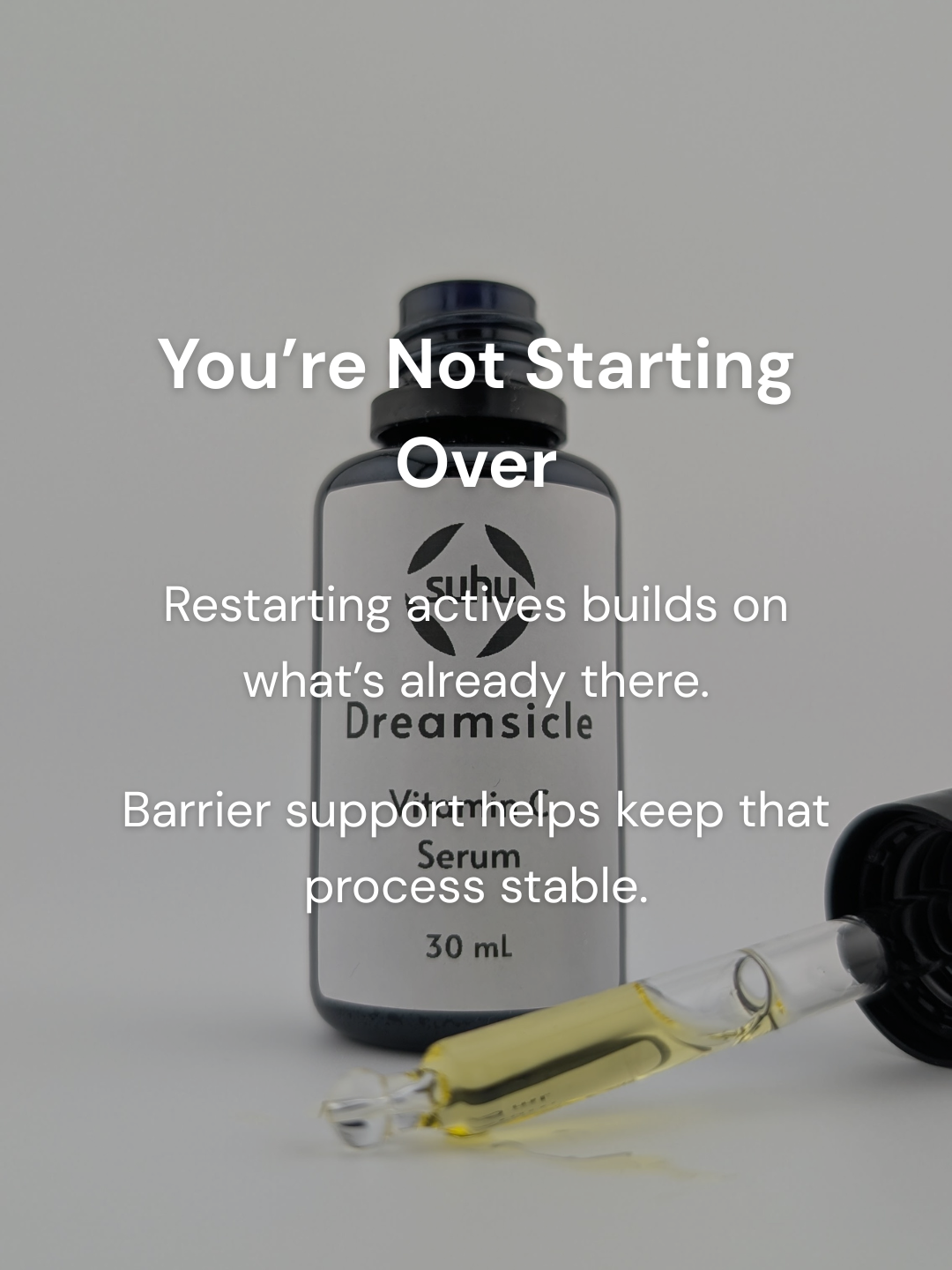
What Holds: When You Restart Actives
What happens when you stop using an active ingredient and then start again?
It often feels like your skin is starting over.
But not everything resets.
Restarting actives changes how the skin responds, but underlying structure and adaptation patterns remain.
This happens because skin retains its barrier architecture and biological pathways even after a pause.
Reintroduction may feel reactive, but it is not a complete reset.
Tolerance Is Dynamic
Tolerance refers to how well skin handles active ingredients over time.
With continued use, the skin adapts to certain actives through changes in cellular turnover and enzyme activity.
When use stops, some of that adaptation decreases.
This happens because biological responses adjust based on exposure levels, particularly with ingredients that influence cell turnover (study).
When reintroduced, the skin may respond more strongly at first.
Gradual reintroduction helps rebuild tolerance without overwhelming the barrier.
The Barrier Does Not Reset Completely
Even if sensitivity increases, the skin barrier does not return to an untouched state.
The stratum corneum retains its structural organization, including lipid arrangement and corneocyte layering.
These components continue to regulate water loss and external exposure.
This happens because the barrier is a stable, self-regulating system that does not fully revert after short-term changes in routine (review).
Previous exposure still shapes how the skin responds, even if tolerance has shifted.
Irritation and Recovery Follow Patterns
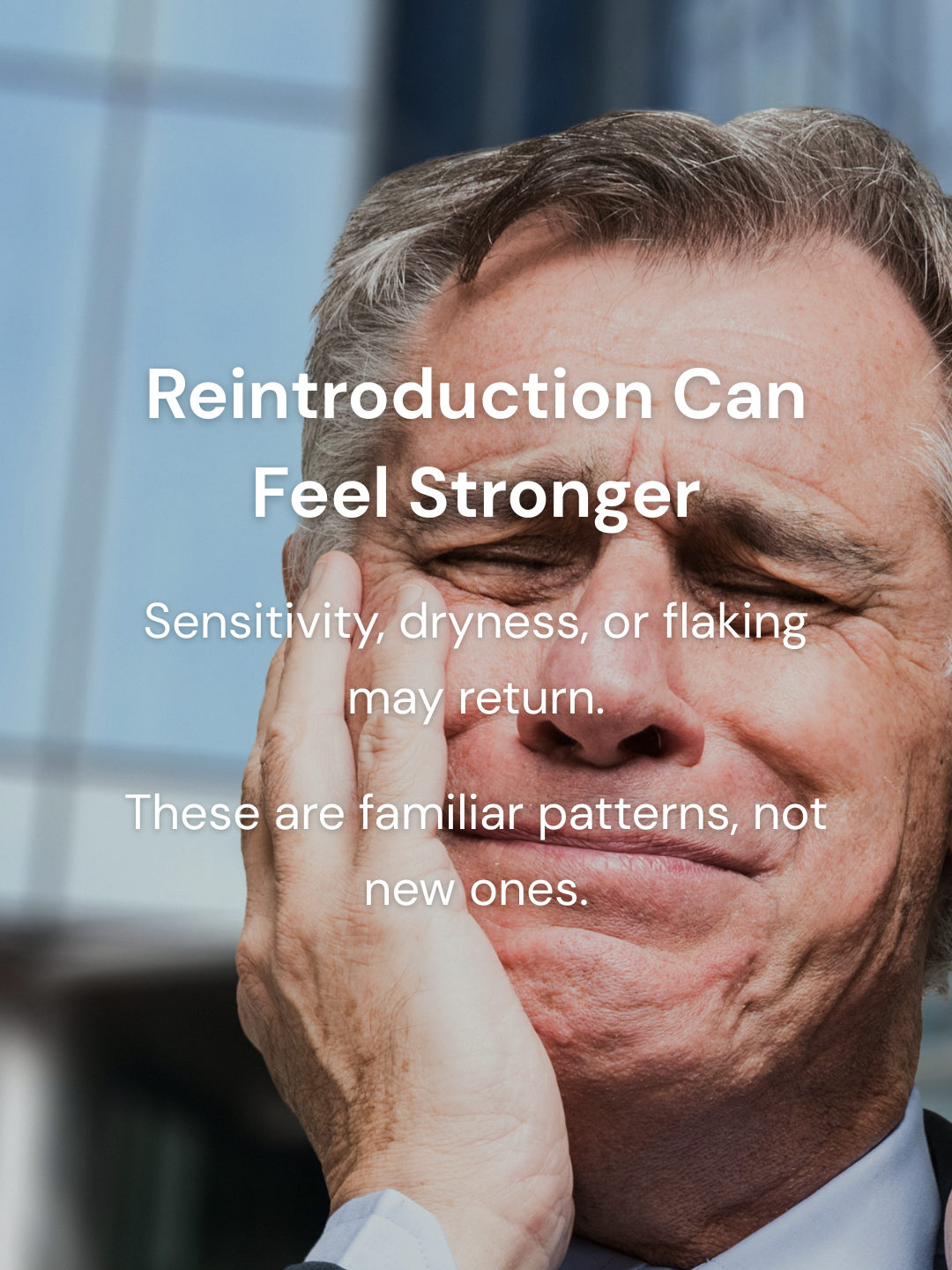
When actives are reintroduced, irritation often follows recognizable patterns.
Dryness, flaking, or sensitivity can occur as the skin adjusts again.
These responses are typically temporary and tied to barrier disruption.
This happens because active ingredients can increase transepidermal water loss during early use phases, especially when the barrier is not fully adapted (study).
With controlled reintroduction, the skin begins to rebalance and restore barrier function.
What This Looks Like in Practice
When restarting actives, you may notice:
quicker onset of sensitivity compared to initial use
similar reaction patterns as before
faster stabilization when reintroduced gradually
These patterns reflect retained biological structure combined with reduced short-term tolerance.
Why This Matters for Skin
Stopping and restarting actives is common, especially during seasonal shifts or routine changes.
Understanding what holds allows for more controlled reintroduction.
The goal is not to avoid reaction entirely, but to manage how the skin adjusts.
Consistent barrier support makes this process more predictable.
Suhu’s Take
We focus on supporting the barrier so the skin can adapt without becoming unstable.
Restarting actives is not about starting over. It is about building back into an existing system.