
Healthy vs Calm: What Winter Skin Is Actually Asking For
In skincare, “healthy” often gets confused with visible results. Glow. Smoothness. Activity. Change.
But winter has a way of challenging that definition. Skin that once looked bright may become reactive. Products that once delivered visible effects now cause discomfort. And suddenly, the pursuit of “healthy” skin starts to feel like work.
In winter, skin often is not asking to be pushed. It is asking to be calm.
Why Calm Skin Is Often Healthier in Winter
Cold air, low humidity, indoor heating, and behavioral stressors all increase strain on the skin barrier. When this happens, skin shifts into a defensive state (review).
Redness, sensitivity, tightness, and stinging are not cosmetic flaws. They are signals that the skin is working harder to protect itself.
In this context, calm skin often reflects better barrier function, lower inflammation, and improved resilience. These are core markers of skin health, even if they are less visually dramatic (review).
The Problem With Chasing Activity
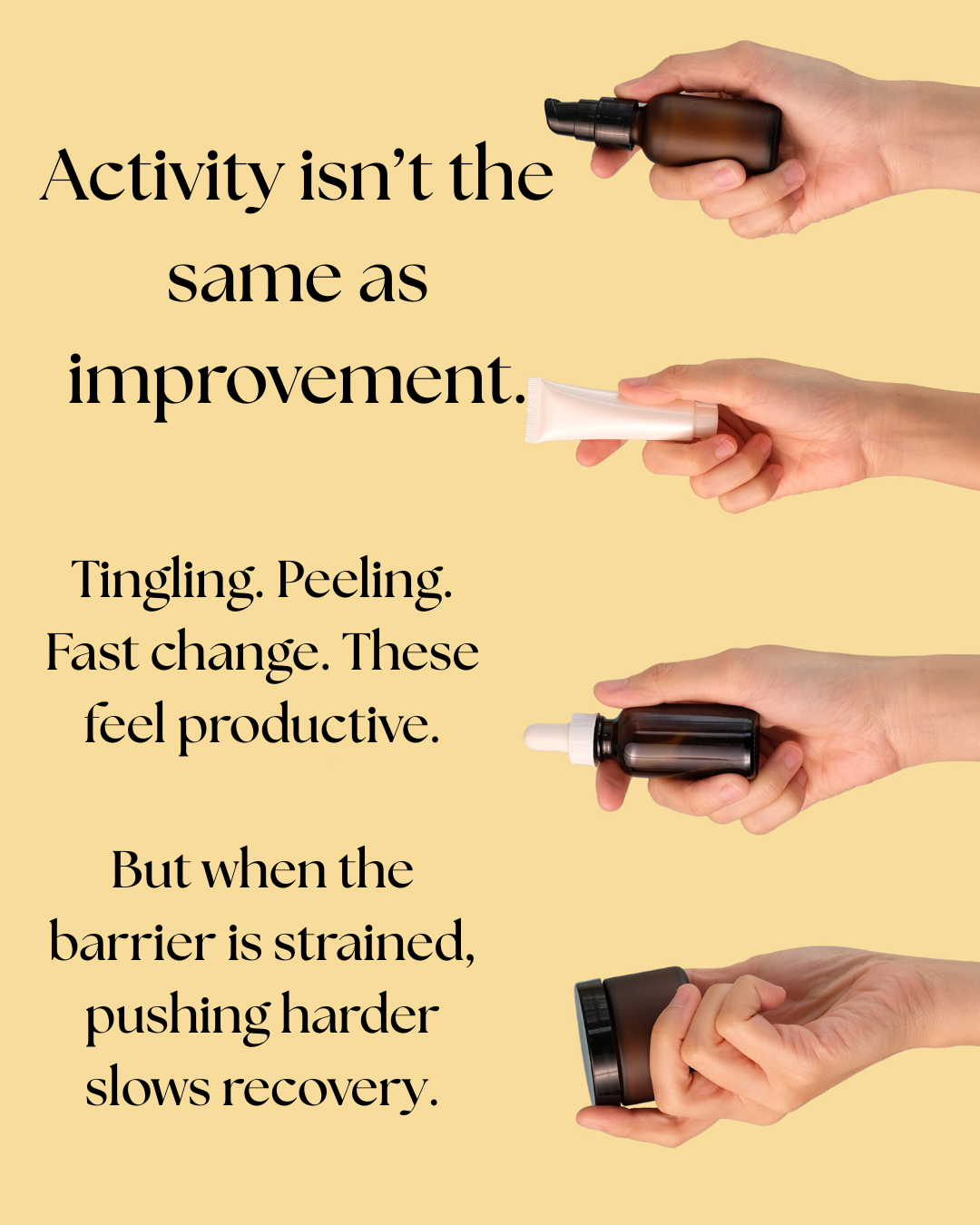
Many skincare routines are built around visible activity. Tingling. Peeling. Brightening. Fast change.
These signals are often interpreted as proof that a product is working. But in winter, when the skin barrier is already compromised, pushing for activity can increase irritation and slow recovery (study).
Research shows that inflammation and barrier disruption impair the skin’s ability to regulate itself (review). Skin may look temporarily smoother or brighter, but underlying stress accumulates.
Activity is not the same as improvement.
What Calm Skin Actually Looks Like
Calm skin is often subtle.
It feels comfortable throughout the day.
It does not sting when products are applied.
It recovers quickly from cleansing or environmental exposure.
It feels predictable rather than reactive.
These signs indicate that the barrier is functioning and inflammation is controlled. From a physiological standpoint, this is a strong foundation for long-term skin health (review).
Why Winter Is Not the Time to Force Results
Skin tolerance changes with the environment. Winter reduces the margin for error.
Actives that increase cell turnover or penetration may be well tolerated in warmer months but feel overwhelming in colder ones (review). This does not mean those ingredients are bad. It means timing matters.
In winter, restraint often preserves progress better than intensity.
Reframing What “Healthy” Means Seasonally
Healthy skin is not a fixed aesthetic. It is a functional state that shifts with conditions.
In summer, healthy skin may tolerate more stimulation.
In winter, healthy skin prioritizes protection and recovery.
Redefining success as comfort, resilience, and stability allows skincare routines to adapt instead of escalate.
Letting Calm Be Enough
There is a quiet confidence in calm skin. It does not demand constant intervention. It does not require explanation.
When skin is calm, it is often doing its job well.
Winter skincare does not need to chase transformation. It needs to protect what is already working.
Bottom Line
In winter, calm skin is often the clearest sign of healthy skin.
Comfort, stability, and resilience matter more than visible activity. When routines support calm, the skin is better positioned to recover, adapt, and thrive over time.
Sometimes the healthiest choice is to stop pushing and let the skin settle.
