
What Holds: After Weeks of Use
What actually holds up after weeks of using the same product?
Early changes can be noticeable, but they do not always reflect how a product will perform over time.
Consistency reveals a different pattern.
After weeks of use, skin responses become more stable as adaptation occurs.
This happens because repeated exposure allows the skin to regulate hydration, lipid organization, and response to external inputs.
Effects that persist tend to reflect structural changes rather than short-term reactions.

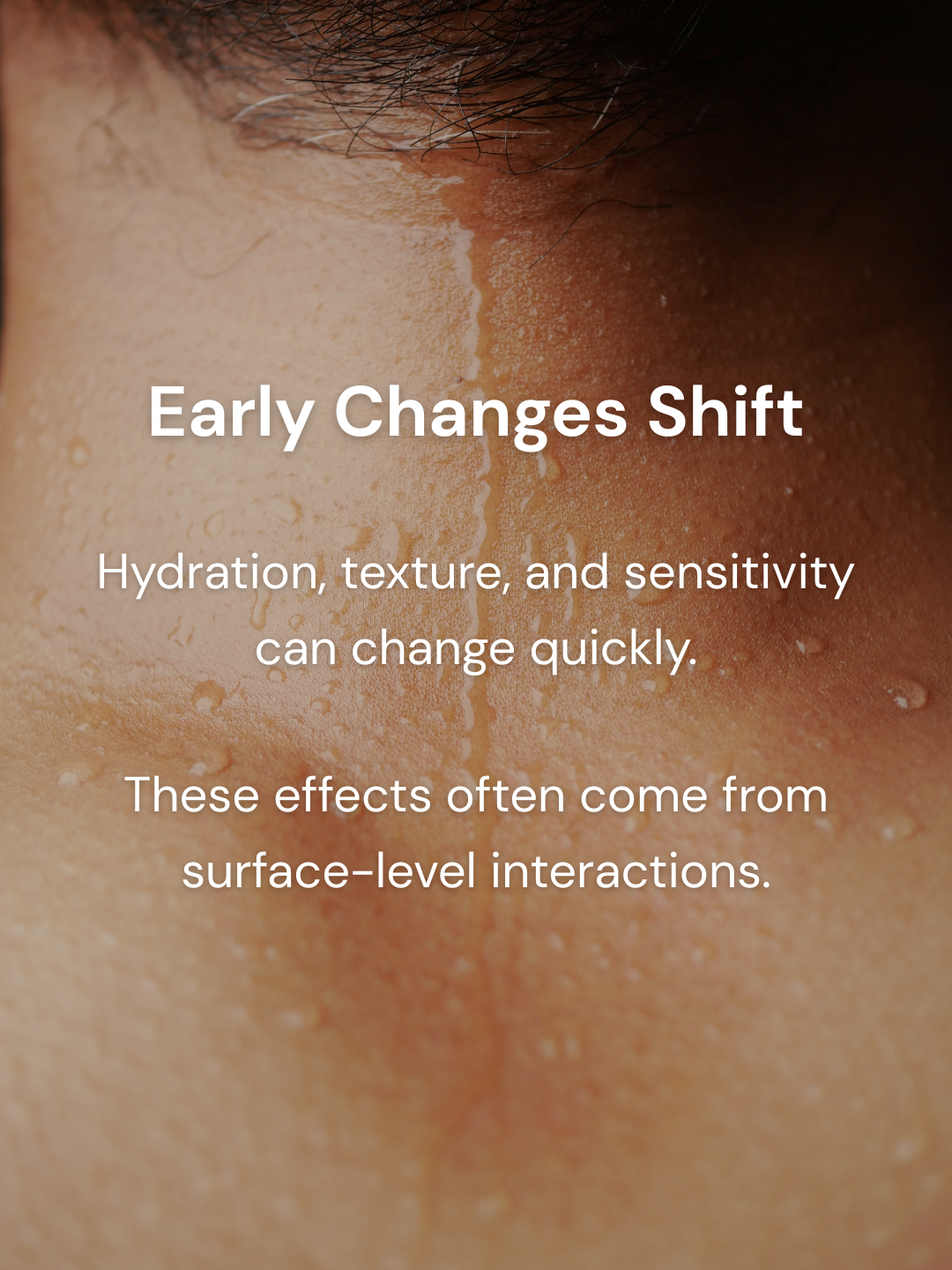
Early Responses Shift Over Time
Initial use often produces visible changes.
These can include increased hydration, slight sensitivity, or shifts in surface texture.
Some of these responses appear quickly because they involve the outermost layers of the skin.
Hydration levels can change within hours, and surface smoothing can occur within days.
These are real effects, but they are not always stable.
This happens because early responses are often driven by immediate interactions with the stratum corneum rather than deeper structural adjustments.
Over time, some of these changes level out.
Others fade as the skin adjusts to repeated exposure.
The Barrier Becomes More Organized
With consistent use, the skin barrier begins to stabilize.
The stratum corneum is composed of corneocytes surrounded by a lipid matrix.
These lipids play a central role in regulating water retention and protecting against external stress.
Repeated exposure to supportive formulations can influence how these lipids are organized.
Improved organization reduces variability in water loss and sensitivity.
This happens because lipid synthesis and arrangement are ongoing biological processes that respond to consistent conditions (review).
More uniform structure tends to support more predictable skin behavior.

Water Loss Becomes More Predictable
Transepidermal water loss reflects how much moisture escapes from the skin.
In the early stages of a routine, water loss can fluctuate as the barrier adjusts.
This can show up as alternating dryness and comfort.
With continued use, these fluctuations often decrease.
This happens because barrier function becomes more regulated, reducing variability in moisture retention (study).
A more stable hydration pattern usually follows.

Skin Responds to Repetition
Skin adapts to repeated exposure over time.
Consistent application creates a pattern the skin can respond to.
Irregular use tends to interrupt that process.
Cell turnover, lipid production, and enzyme activity all adjust based on ongoing input.
These changes do not occur instantly, but they accumulate.
This happens because biological systems respond to sustained conditions rather than isolated events (review).
Regular use supports gradual, consistent adaptation.
What This Looks Like in Practice
After several weeks of consistent use, you may notice:
fewer swings between dryness and oiliness
more consistent texture and feel
reduced sensitivity to small environmental changes
These patterns tend to reflect stabilization rather than temporary effects.
Products that felt subtle early on may become more reliable over time.
Others that produced strong initial responses may feel less noticeable as the skin adjusts.
Why This Matters for Skin
Short-term results can be useful, but they do not always represent long-term performance.
What holds over time provides a clearer picture of how a product supports the skin.
Consistency allows these patterns to become visible.
Evaluating skincare over weeks rather than days leads to more accurate expectations.
Suhu’s Take
We pay attention to how formulations perform over time, not just on first use.
Stability, consistency, and repeatability are what define long-term results.
