
What “Plant-Based” Actually Means
“Plant-based” (or “plant-derived”) has become one of the most common phrases in modern skincare. It sounds specific and reassuring. It suggests something gentle, sustainable, and close to nature.
But chemically, the term is broader than most people realize.
Understanding what plant-derived actually means helps separate origin from performance, and marketing language from material reality.
Plant-Derived Refers to Source, Not Structure
When an ingredient is described as plant-derived, it means the starting material originated from a plant. That is all the term guarantees.
The ingredient may be:
Cold-pressed directly from a plant source
Chemically modified after extraction
Fully refined and purified
Structurally identical to a compound that could also be synthesized in a lab
Many cosmetic ingredients begin with plant sugars, starches, or oils and are then processed into stable, skin-compatible molecules. Glycerin, for example, is often plant-derived and widely used as a humectant because it attracts water into the skin. Its effectiveness is tied to its molecular behavior, not simply its origin (review).
Plant-derived describes the feedstock. It does not describe how much processing occurred afterward.
Processing Does Not Automatically Reduce Quality
There is a common assumption that the less processed an ingredient is, the better it must be. That is not always the case.
Processing can improve stability, safety, and consistency. Many raw plant materials are unstable or highly variable in composition. Refinement can remove contaminants, reduce oxidation risk, and improve skin tolerance.
For example, fatty acids extracted from plant oils are often refined to remove impurities while preserving their barrier-supportive properties. Research on topical plant lipids shows that essential fatty acids support barrier repair and reduce inflammation when formulated appropriately (review).
The key factor is not whether processing occurred. It is whether the final molecule supports skin function.
Plant-Derived Does Not Mean Unmodified
Some plant-derived ingredients are chemically modified after extraction. This does not make them synthetic in the conventional sense, but it does mean they are no longer identical to their raw botanical form.
Modification is often done to improve penetration, reduce irritation, or enhance stability. Vitamin C derivatives are one example. Certain forms begin with plant-based precursors and are then stabilized for use in cosmetic formulations.
The benefit depends on how the molecule interacts with skin biology, not on whether it remained unchanged from its botanical source.
Safety and Compatibility Depend on Behavior
The skin barrier functions through a structured lipid matrix composed of ceramides, cholesterol, and fatty acids. Ingredients that integrate well into this system are typically better tolerated (study).
Whether an ingredient is plant-derived or laboratory synthesized does not inherently determine compatibility. Molecular size, polarity, stability, and concentration are what influence absorption and irritation potential.
Natural origin does not override chemistry.
Why the Term Still Matters
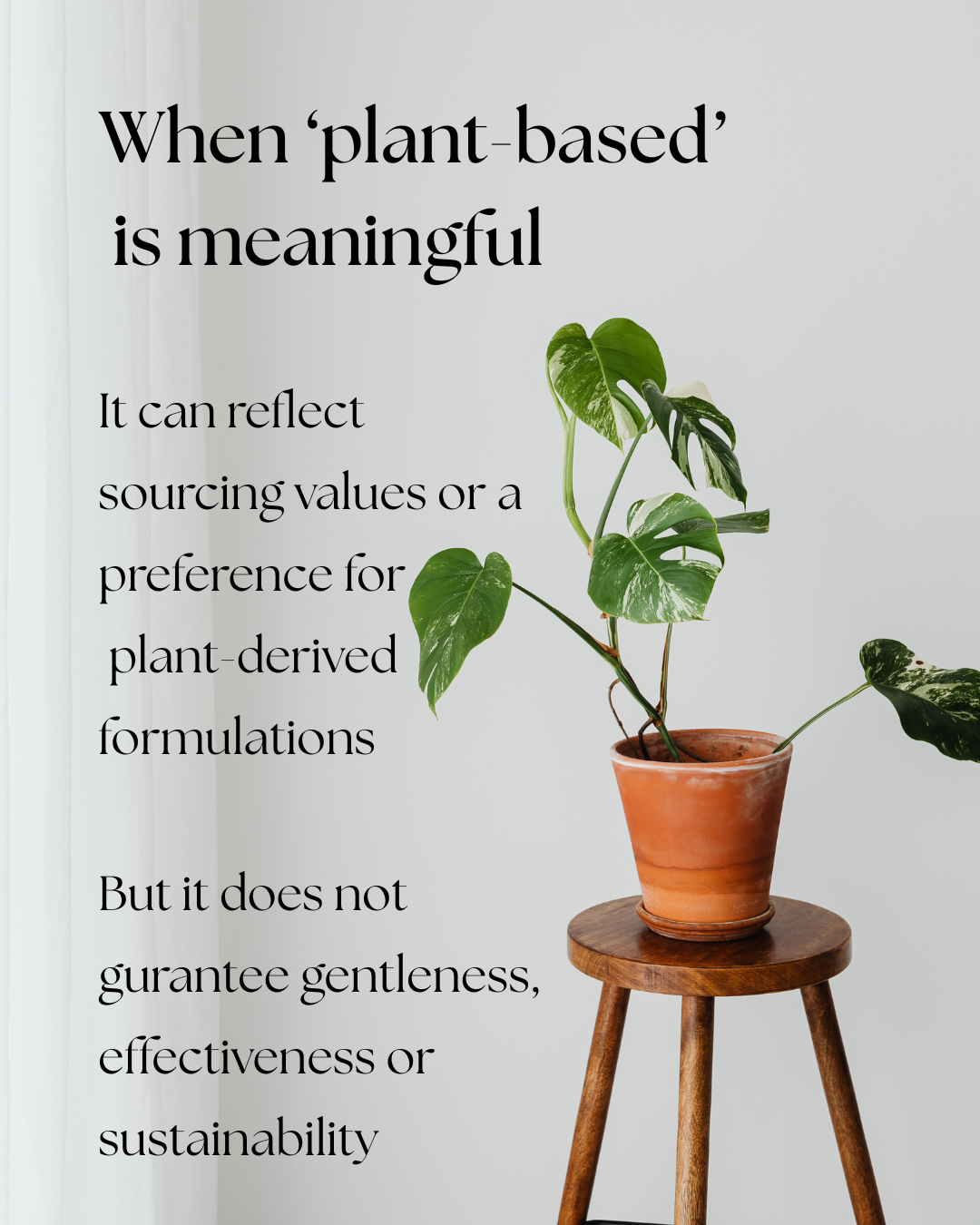
Plant-derived can be meaningful in two contexts.
First, it may reflect sourcing values. Some consumers prefer ingredients that originate from renewable agricultural sources rather than petrochemical feedstocks.
Second, it can signal alignment with plant-based formulations, which may matter for ethical or environmental reasons.
What the term does not guarantee is gentleness, effectiveness, or sustainability. Those require transparency about sourcing, processing, and formulation choices.
A Clearer Way to Read the Label
When you see plant-derived on a label, it is useful to interpret it as a starting point, not a conclusion.
Ask:
Is the ingredient stable in this formula
Is there documentation about sourcing practices
Does the formulation support barrier health
Is the concentration appropriate
These questions move beyond origin and toward performance.

Bottom Line
Plant-derived describes where something began. It does not describe how it behaves.
In skincare, what matters most is not the story of origin, but the function of the final molecule on the skin.
