Where Ingredients Actually Come From
Skincare labels usually begin at the point of formulation. The ingredient list is presented as if it tells the whole story. In reality, every ingredient has a history long before it reaches a lab.
Understanding where ingredients actually come from changes how we think about quality, sustainability, and performance. It shifts the focus from the finished bottle back to soil, crops, chemistry, and processing.
Most Cosmetic Ingredients Start as Agricultural Materials
Many skincare ingredients begin as plants grown for food, fiber, or industrial use. Seeds are pressed for oils. Sugars are fermented into alcohols. Starches are processed into humectants and emulsifiers.
For example, glycerin is often derived from plant oils and functions as a water-binding humectant in the skin. Its effectiveness in improving hydration and barrier function is well documented in dermatologic research (review).
Plant oils used in skincare may originate from crops like sunflower, jojoba, or rosehip. Their fatty acid profiles influence how they interact with the skin barrier, particularly in supporting lipid repair and reducing inflammation (review).
In these cases, the story begins with farming.
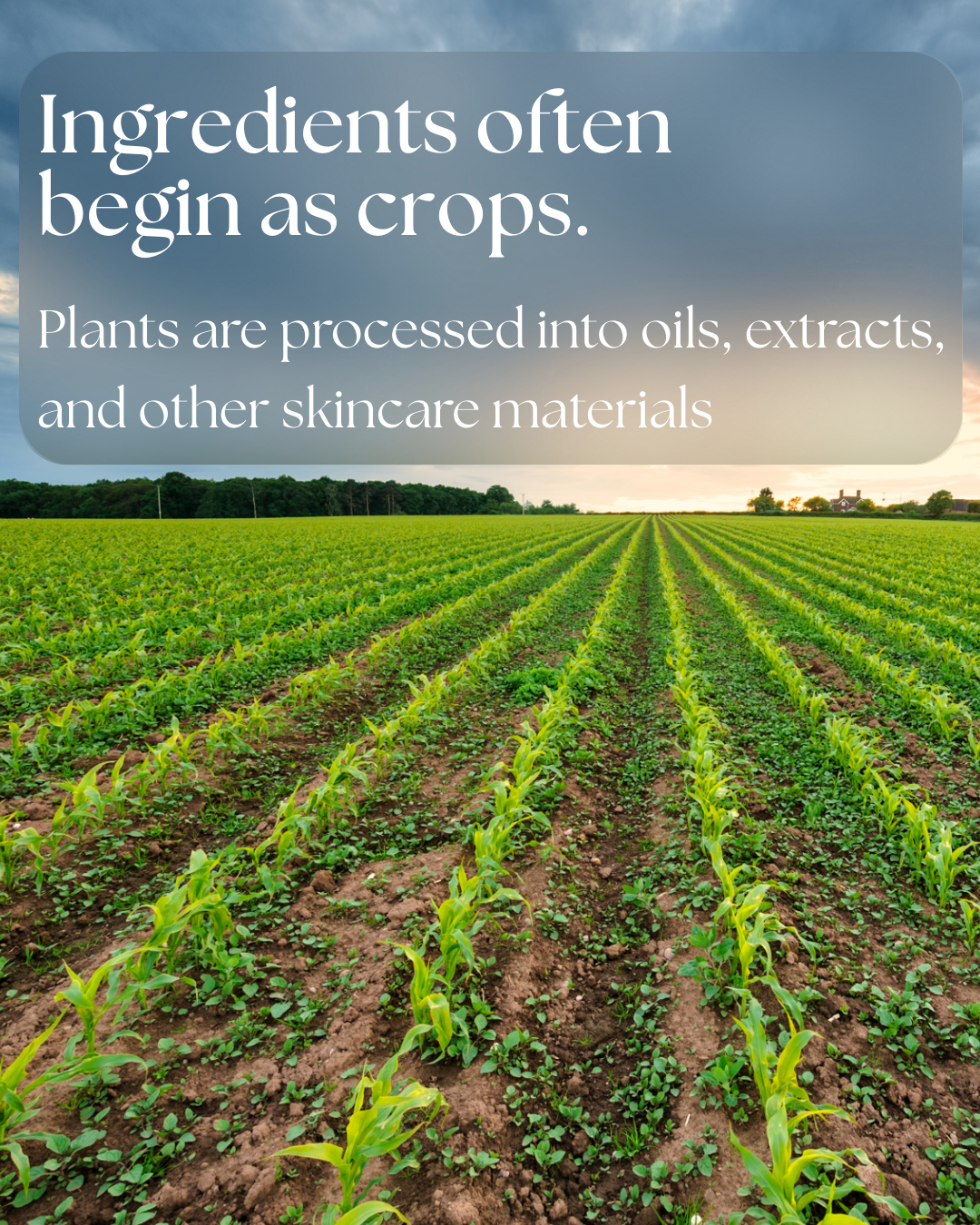
Extraction and Processing Shape the Final Ingredient
Harvesting is only the first step. How an ingredient is extracted and refined determines its stability, purity, and performance.
Cold pressing uses mechanical force to extract oils without high heat or solvents. This can preserve certain bioactive compounds but may also result in more variability from batch to batch.
Solvent extraction can increase yield and consistency, but it introduces additional processing steps and requires careful purification.
Refinement removes impurities and can improve stability. Over-refinement, however, may strip away beneficial compounds. There is no universal best method. The right approach depends on the ingredient’s intended function and the formulation context.
The key point is that processing decisions matter as much as origin.
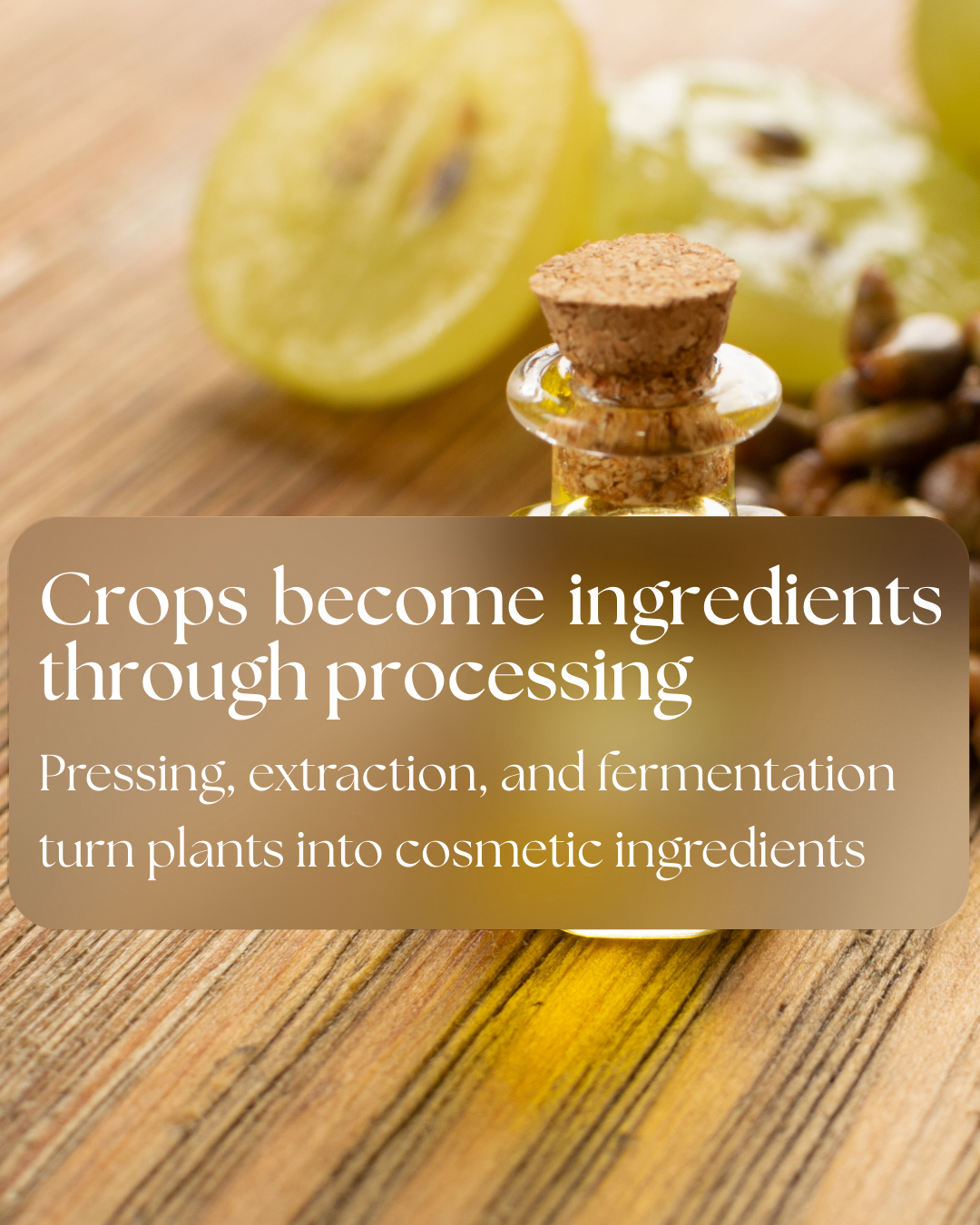
Some Ingredients Begin in Fermentation
Not all ingredients are directly pressed or extracted. Many begin through fermentation.
Plant-derived sugars can be fermented by microorganisms to produce compounds like hyaluronic acid or certain amino acids. These processes are common in modern cosmetic manufacturing and allow for consistent, high-purity materials.
Hyaluronic acid, widely used for hydration, is typically produced via bacterial fermentation today rather than extracted from animal sources. Its ability to bind water and support skin hydration is supported by research on its biological function in the skin (source).
Fermentation is still agriculture at its base. It simply uses microbes instead of fields.
Laboratory Synthesis Is Often Plant-Linked
Even ingredients described as synthetic frequently begin with plant feedstocks.
Plant sugars and oils can serve as the raw materials for chemical reactions that produce stabilized derivatives or emulsifiers. The final molecule may be highly refined and consistent, but its origin is still agricultural.
The distinction between natural and synthetic becomes less rigid when you follow the supply chain backward. Many cosmetic ingredients sit somewhere in the middle, beginning with plants and ending in a refined, standardized form.
What matters most is not whether a lab was involved. It is whether the final ingredient is safe, stable, and compatible with the skin barrier.
Soil and Supply Chains Influence Quality
Agricultural practices influence more than sustainability. Soil health, pesticide use, and harvest timing can affect the composition of plant oils and extracts.
Organic certification frameworks address how crops are grown and processed, with standards defined and enforced through the USDA National Organic Program (source).
While organic status does not change molecular structure, it can influence residue levels and environmental impact. For brands that prioritize sustainability, these upstream decisions are part of the formulation process.
Where an ingredient comes from includes the land and the labor behind it.
Why This Context Matters
When we reduce skincare to ingredient names alone, we miss the broader system.
An oil is not just an oil. It is the result of farming choices, extraction methods, transportation, refinement, and formulation decisions.
Barrier-supportive ingredients, such as essential fatty acids and structured lipids, function because of their molecular properties and how they integrate into the skin’s lipid matrix (review). Those properties are shaped by the journey from raw material to finished ingredient.
Understanding origin adds context, not complication.
Bottom Line
Skincare does not begin in a lab. It begins in fields, fermentation tanks, and supply chains.
Where ingredients actually come from tells you more than a label ever could.